
For all children and young people – but especially Aboriginal children and young people – changes to the whole system will result in children in care arrangements that meet their physical, emotional, cultural, and spiritual needs in keeping with the Aboriginal and Torres Strait Islander Child Placement Principle.
Following an open tender procurement process, 16 providers have been awarded a new contract to deliver OOHC services in WA over the next five to seven years. This includes five new ACCOs who will be providing OOHC services for the first time, alongside Yorganop who already delivers culturally safe OOHC services in Western Australia.
The Western Australian Department of Communities and Kinship Connections Aboriginal Corporation has recently committed to working together via the Department’s Aboriginal Community Controlled Organisation (ACCO) Strategy 2022—2032.
Our founder/CEO Ann Hawke was part of the Strategy working group for over 3 years, made up of Aboriginal people from all over WA to advise and work with the Department to make changes to child protection.
The ACCO Strategy is about empowering Aboriginal children, families, and Communities to choose their future from secure and sustained foundations enabled through culturally secure ACCO services.
This Strategy aligns with the National Agreement on Closing the Gap (National Agreement) and the WA Aboriginal Empowerment Strategy 2021—2029 demonstrating the Department of Communities’ long-term commitment to self-determination for Aboriginal people.
In a nutshell, the ACCO Strategy is about grassroots Aboriginal Community leadership through self-determination. The Strategy responds to the need to improve how the Department of Communities procures and delivers services for Aboriginal children, families, and Communities by supporting the empowerment of ACCOs to deliver place-based, culturally appropriate services across WA.
As an ACCO, self-determination is central to what Kinship Connections does; our purpose is to grow to deliver culturally secure services by us, for us, to our Communities. By advocating for decolonised service delivery, program design, policy, and legislation, we embody a strengths-based example of self-determination in action to work toward the healing of our children, families and communities.
Kinship Connections Aboriginal Corporation (KCAC) is committed to ensuring a quality FCSS program is provided to carers, children, and the young people in their care.
What is the Child Placement Principle?
The Aboriginal and Torres Strait Islander Child Placement Principle aims to keep children connected to their families, communities, cultures and country and to ensure the participation of Aboriginal and Torres Strait Islander people in decisions about their children’s care and protection.
The Principle was established to recognise the importance of safe care within family and culture to the best interests of children, as well as to ensure that the actions that resulted in the Stolen Generations are not repeated. Its components include both prevention of entry into out-of-home care and reunification to ensure culturally connected placements and to enable Aboriginal and Torres Strait Islander families and communities to participate in child protection decision-making.
The aims of the Principle are:
- recognition and protection of the rights of Aboriginal and Torres Strait Islander children, family members and communities in child welfare matters
- self-determination for Aboriginal and Torres Strait Islander people in child welfare matters
- reduction in the disproportionate representation of Aboriginal and Torres Strait Islander children in the child protection system.
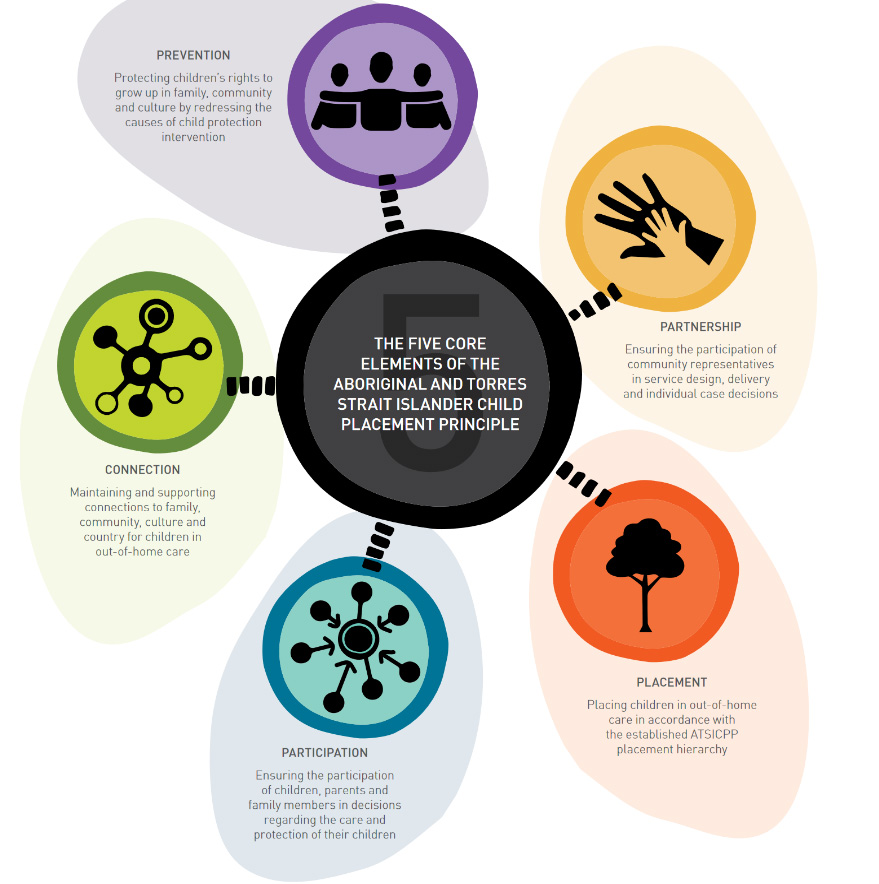
The five elements of the Principle are: Placement, Connection, Prevention, Partnership and Participation.
Trauma Informed Responsive Approach for Service Delivery
Trauma-informed approaches allow individuals and families to better understand the impact of multiple causes of trauma and distress, including unresolved or accumulated trauma, on one’s current circumstances, and supports holistic healing and recovery.
Kinship Connections wants to use these approaches to our service as a culturally secure and safe way to address trauma so that we can empower and build on the strengths of Aboriginal families and communities encompassing Aboriginal concepts of social, emotional, cultural and spiritual wellbeing.
Cultural knowledge, cultural identity and cultural strengths need to be drawn upon to address healing needs, and to build whole-of-person and whole-of family resilience.
Kinship Connections Family Support Service draws on best practices from research that shows for Aboriginal people the Trauma Informed Responsive Approach works best with service delivery, which centres on Caseworkers interactions to be able to provide support to build competencies to the Caregivers and their children.
At the centre of the trauma informed responsive approach is the Kinship Connections approach for Healing from Intergenerational trauma framework.